We’ve all found ourselves in those awkward conversations where someone starts gossiping and you can almost feel the drama building. Sometimes it’s harmless chatter, but other times it crosses a line and turns into something genuinely hurtful. While many people know when to stop, not everyone gets the hint—and a few seem to thrive on stirring the pot.
That’s exactly what happened in today’s story. One person shared how their mother-in-law had a habit of gossiping about just about everyone, including close family members. But things took a much darker turn when she made cruel remarks about the spouse of one of her children and even targeted a disabled family member. Instead of staying quiet, the author decided the people being talked about deserved to know the truth. What happened next was emotional, messy, and full of family drama. Keep scrolling to see how it all unfolded.
Gossiping about family can be a dangerous habit, often leading to broken trust, hurt feelings, and unnecessary drama

Image credits: Daniel & Hannah Snipes / Pexels (not the actual photo)
One person shared how their mother-in-law crossed the line with her constant gossip, sparking a painful family conflict

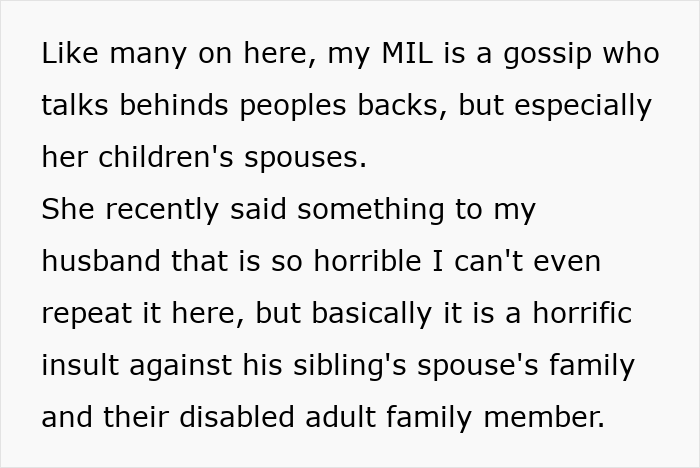
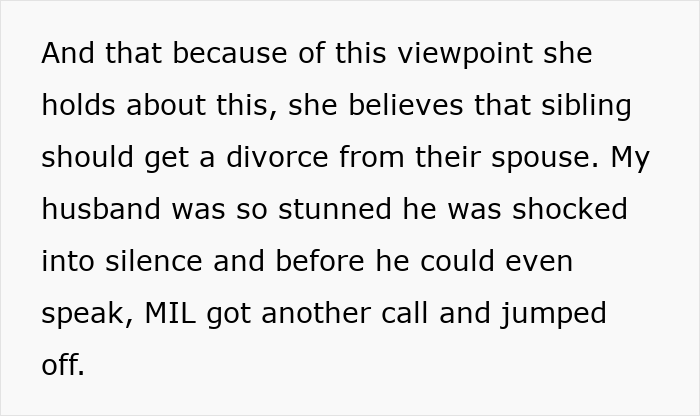

Image credits: bernardbodo / Envato (not the actual photo)
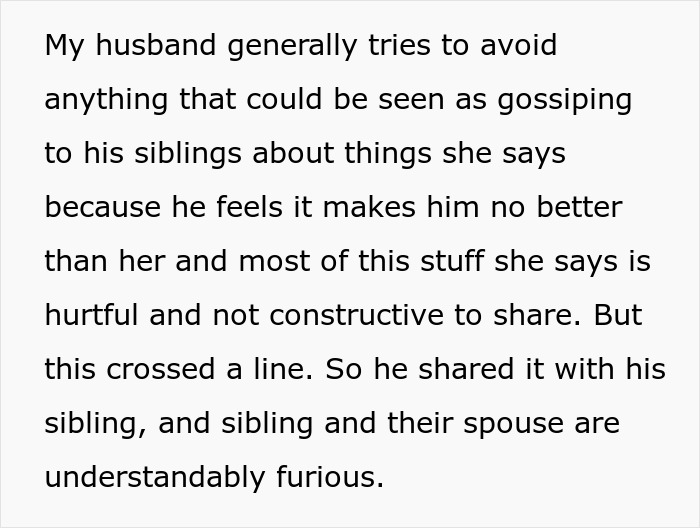
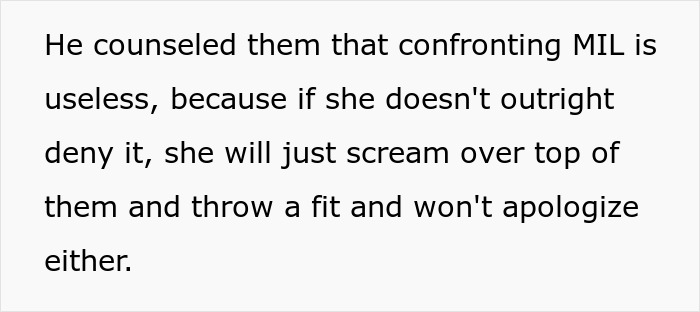
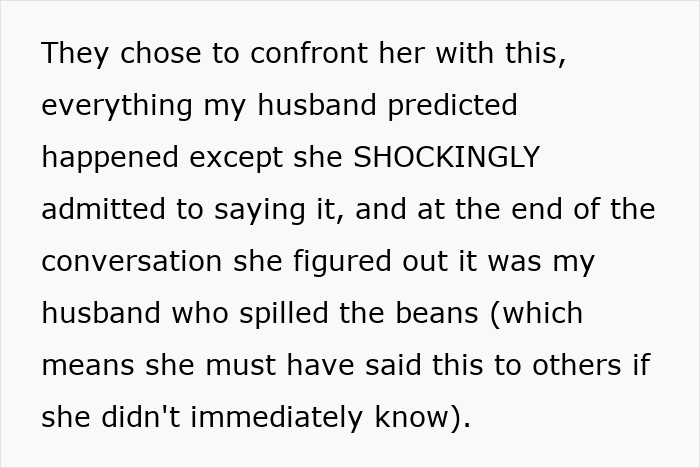
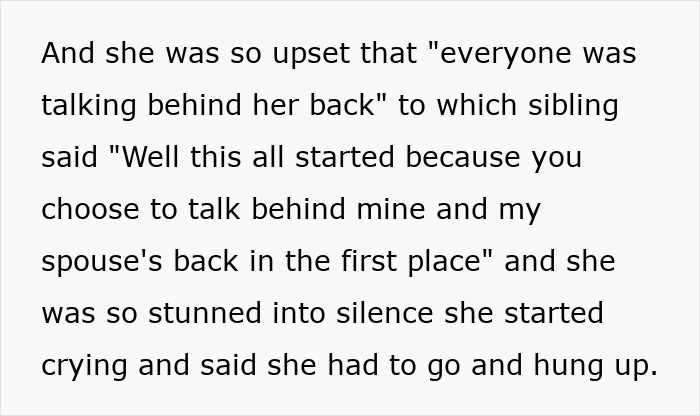

Image credits: Miljan_Zivkovic / Envato (not the actual photo)

Image credits: mimbulusmimbletonia8

Image credits: Vitaly Gariev / Pexels (not the actual photo)
Humans use gossip as a sophisticated social survival tool
Whether we call it “spilling the tea” or a quick “watercooler chat,” gossip is often dismissed as a guilty pleasure or a social vice. Yet far from being idle chatter, it is one of the most sophisticated tools in the human survival kit. It serves as a biological “background check,” helping us map the complex web of who is helpful, who is a liar, and who can be trusted with a secret. By sharing stories about others, we aren’t just passing time; we are participating in an ancient practice of social monitoring that has kept our species organized for millennia.
This drive to talk behind backs actually stretches back to our earliest days, when survival depended on knowing exactly who would share their food and who would steal it. Evolutionary psychologist Robin Dunbar famously described gossip as “vocal grooming,” comparing it to the way primates bond by picking bugs off one another. While monkeys use their hands to build trust, humans use their stories. When someone leans in to share a “secret” with you, your brain releases oxytocin (the “bonding hormone”) which creates an instant, physical feeling of trust and safety with the speaker, effectively “grooming” the relationship through words.
The reason gossiping feels so good isn’t just in your head—it’s a hardwired chemical reaction in your caudate nucleus, the brain’s primary reward center. The moment you hear “insider” news, your system triggers a rush of dopamine, the same chemical responsible for the highs of pleasure and even addiction. This makes the act of sharing “tea” feel emotionally rewarding and physically satisfying, reinforcing a deep-seated habit to seek out the next piece of juicy information. Essentially, it is the brain’s way of rewarding you for gathering data that might keep you safe or socially relevant.
Beyond the immediate chemical high, these dopamine hits serve a greater social purpose by helping us build a consensus on what is “right” and “wrong.” When you and a friend agree that a third person’s behavior was “crazy,” you are doing more than just judging; you are aligning your social values and confirming that you both follow the same social norms. This “shared reality” makes you feel more secure in your group and more certain that your own worldview is correct, effectively using gossip to strengthen the bonds of your immediate circle.
This social bonding is why modern research suggests that gossip is far more than idle “trash talk”—it is a sophisticated survival tool used to determine who is truly trustworthy. For instance, a massive study tracking over 5,000 real-world conversations in a Dutch community found that most gossip centers on whether people are cooperative or “flaky.” This acts as a peer-to-peer navigation system, backed by findings from Stanford and the University of Maryland (UMD), which shows that sharing these “reputational tips” helps us gravitate toward reliable partners while dodging selfish ones.

Image credits: Kindel Media / Pexels (not the actual photo)
It’s important to not gossip too much or weaponize it maliciously
Refining this idea, study co-author Dana Nau, a Professor Emeritus at UMD’s Department of Computer Science and Institute for Systems Research, points out that gossip functions as a form of collective intelligence. Rather than every individual having to be personally burned by a “bad actor” to learn a lesson, the community crowdsources that knowledge to save everyone the trouble. It essentially creates a social warning system that maintains order without the need for constant, awkward confrontations every time someone breaks a promise or misses a deadline.
Building on this collective intelligence, gossip also serves as a powerful social lubricant that encourages us to bring our best selves to the table. The awareness that our behavior will likely be discussed the moment we leave the room creates a “soft” pressure to remain helpful and honest. It is essentially a community-powered Yelp review for human character; when people know their reputation is a living thing managed by their peers, they are much more likely to contribute positively to the group to avoid a “bad review.”
In this sense, the “tea” we spill today becomes the very foundation of the trust we build tomorrow. By sharing our observations, we aren’t just talking; we are actively constructing a safer, more predictable world where cooperation is the gold standard. But like all things in life, balance is key. Gossiping too much (or leaning into purely negative gossip) can quickly turn this social tool into a weapon. When the goal shifts from sharing helpful information to intentionally damaging someone’s reputation, the “social glue” begins to dissolve. In the end, the most effective gossipers are those who use the tool sparingly and honestly, ensuring that the “tea” they share actually protects the community rather than just burns it down.
In this particular instance, it felt like the mother-in-law crossed a major line by saying horrible things behind her family members’ backs. While we’ve seen that gossip can be a survival tool, her behavior highlights the dark side of that power. Instead of using “vocal grooming” to protect or bond the tribe, she used it to undermine trust and create a toxic environment within her own inner circle. Now, we want to turn it over to you. What are your thoughts on this situation? Do you think there is ever a “gray area” when it comes to venting about family, or did this mother-in-law’s behavior go too far?
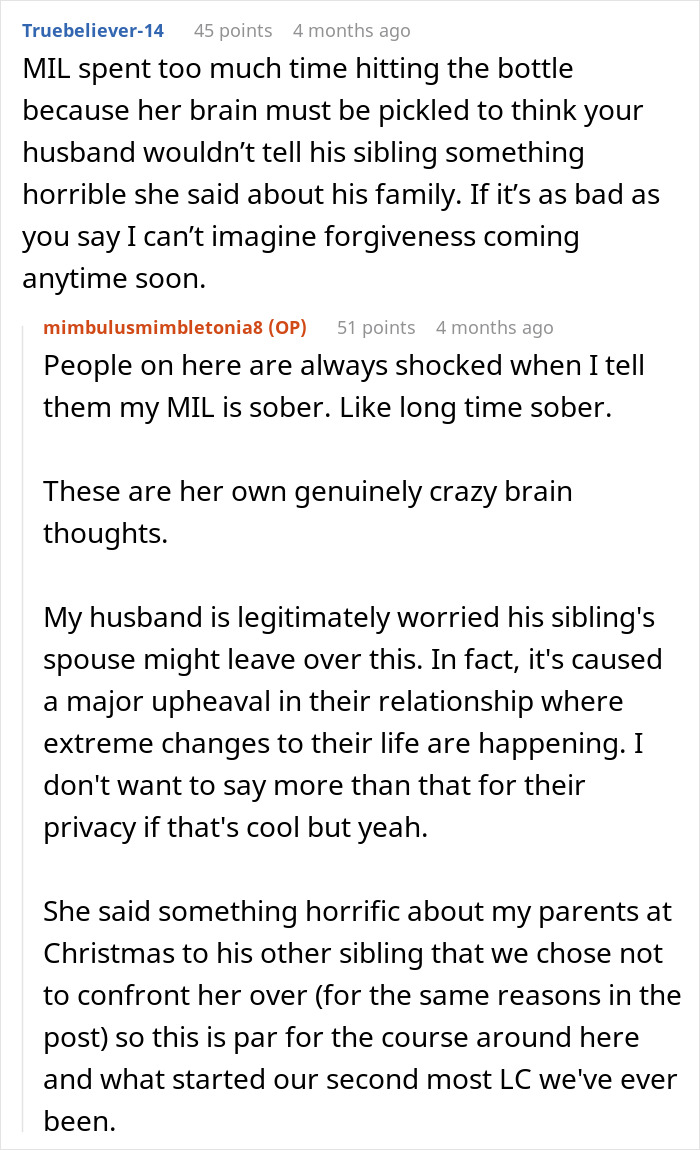
Many people online were quick to point out how toxic they felt the mother-in-law’s behavior was






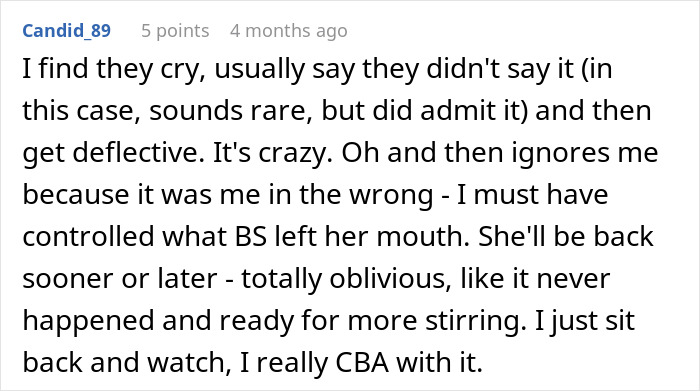
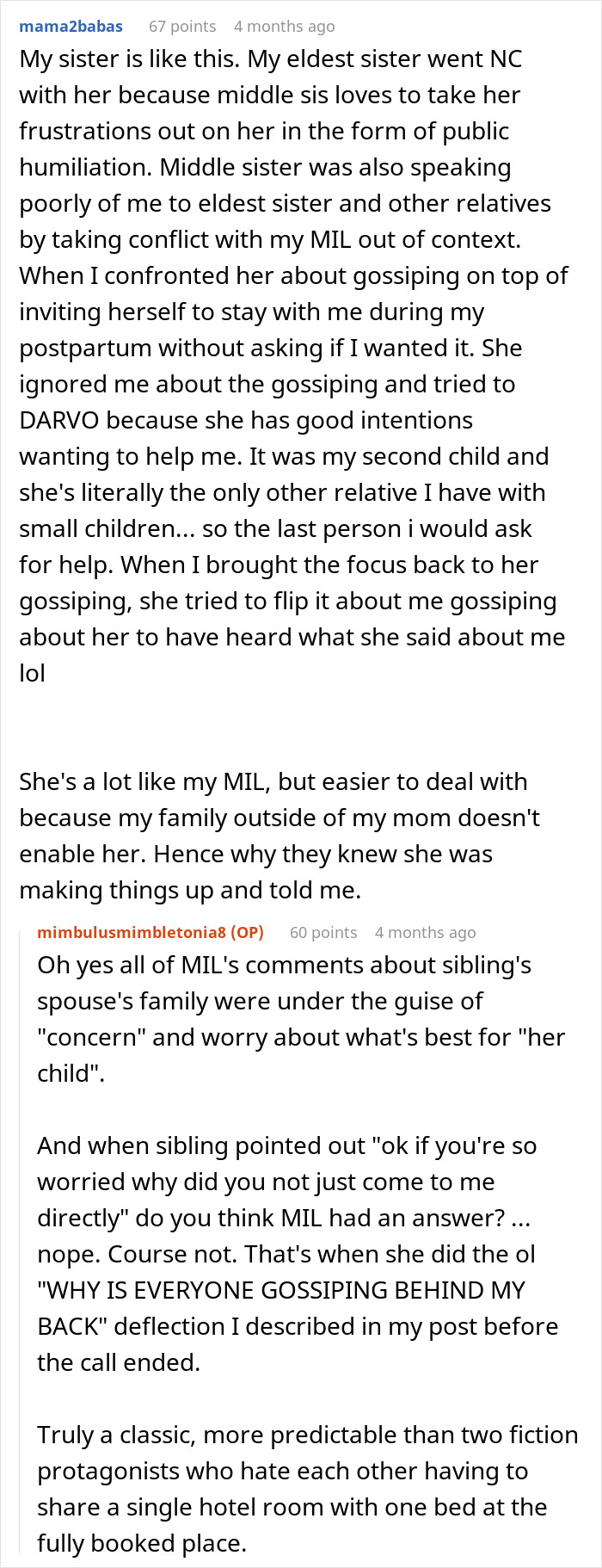
A few commenters also shared similar experiences, revealing they’d dealt with family drama of their own

from Bored Panda https://ift.tt/woF9QIg
via IFTTT source site : boredpanda
