The sad truth about how our lives are constructed is that plastic is basically an unavoidable part of it. No matter how environmentally conscious you are, you encounter plastic – if not at home, then when you go outside.
The reason why plastic is so widespread is not only because it litters the Earth, but also because it litters our bodies. It was reported that microplastics are found even in the weirdest parts of the human body, which is quite worrisome, as we don’t know how it’ll affect our health in the long run.
Plastic is everywhere you look, and no matter how much you try to avoid it, escaping it is nearly impossible
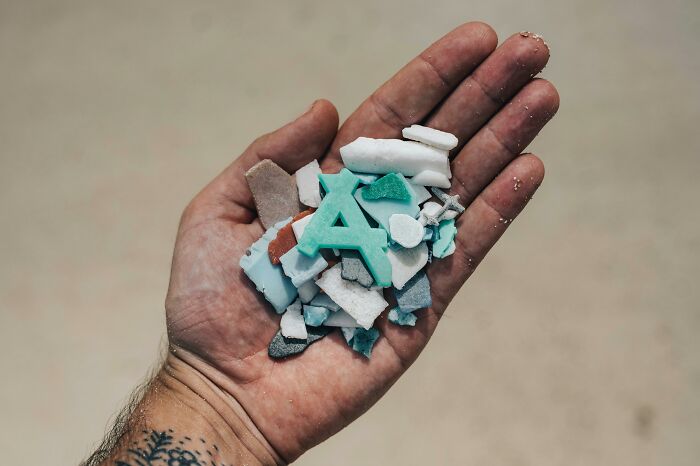
Image credits: Alfo Medeiros / Pexels (not the actual photo)
On February 3, 2025, a study called “Bioaccumulation of microplastics in decedent human brains” was published. It revealed that microplastics were found in humans’ kidneys, livers, and even brains.
Besides this study, researchers have revealed that microplastics were found in breast milk, placentas, bone marrow, and many other places. So, us being “infected” with plastic isn’t some kind of a new thing.
The paper we mentioned first also disclosed that the brain has higher levels of microplastics than any other organ. Adding insult to injury, these particles increased by 50% over the past 8 years.
On average, the studied brain samples contained about 7 grams of microplastics, which is around the same weight as a plastic spoon.
This amount was 10 times greater in the brains of those who suffered from dementia. As you might be aware, dementia is an umbrella term for problems of thinking abilities (like memory, language, and problem-solving) that interfere with daily life. So, the scientists noted that its correlation with microplastics is clear, but further study is needed to establish a direct link, meaning no conclusion can be drawn just yet.
In fact, studies have shown that plastic makes up a percentage of our brain – all due to the microplastics we unknowingly consume

Image credits: Anna Shvets / Pexels (not the actual photo)
The effect microplastics can have on a person’s body is not entirely clear yet. The real consequences won’t be visible for years to come. But there’s a possibility that the plastics are leaching chemicals into the body, or simply their presence itself can cause problems to organs, as it’s alien there.
Let’s take asbestos, for example. Some time ago, it was thought that it wasn’t biologically reactive, and thus wouldn’t cause any problems. Then, it became clear that even tiny pieces of asbestos in the lungs could trigger an immune response and even put a person at higher risk for cancer. So, a similar thing might be possible with microplastics.
At this point, you might be wondering how they even are getting into our bodies. It’s not like we’re actually eating spoonfuls of plastic. Only we basically do, we just don’t realize it.
As the name suggests, microplastics are small particles of plastics, with sizes ranging from 1 nanometer (which is 0.000,000,001 of a meter) up to 5 mm.
And it’s not only the brain – other organs, from lungs to placentas, are full of microplastics too

Image credits: mali maeder / Pexels (not the actual photo)
The main way humans are exposed to these particles is through food and drink. For instance, it was reported that a lot of microplastics were found in oceans, which means they end up in fish, which are later consumed by people, and the same plastic bits end up in them.
Fish isn’t the only “infected” food item – things like salt, honey, chicken, and many others were found to contain microplastics too. Not to mention, drinks, especially those in plastic bottles. The air isn’t so clean either.
Due to such high exposure, humans consume around 5 grams (around the weight of a credit card) of microplastics each week, which ends up being a ticking time bomb in our bodies.
Sadly, due to how common plastic is in our lives, it is basically impossible to fully avoid getting this “infection.” Still, that doesn’t mean we can’t try.
Such revelations are scary, as we can’t be sure what influence microplastics have on our health

Image credits: KATRIN BOLOVTSOVA / Pexels (not the actual photo)
Like opting for alternatives to plastic wherever possible – instead of plastic bottles, lunch boxes, cutlery, cutting boards. Basically, you should choose stainless steel, which doesn’t release plastic bits into the body and environment when used, for anything that touches food.
If you decide to still use plastic products, at least don’t heat them, like by putting them in a microwave, as the heat agitates the chemicals and makes it easier for the microplastics to migrate.
Then, things like eating more greens instead of animal products, taking off your shoes inside the house, and choosing clothes made of natural fabrics are also useful ways to limit exposure to those plastic bits. Unfortunately, as long as ways of production don’t change in our world, that’s the best we can do on a personal level – limit, but not completely avoid.
Since fully avoiding microplastics is simply impossible, we can only take measures to limit exposure – by not using plastic products, opting for vegan diet options more often, and so on

Image credits: ParadigmGauge

Image credits: ZephyrFalk

Image credits: antijudaic19165

Image credits: CodeChap

Image credits: NADS_under

Image credits: pfunkin1

Image credits: darcydarnoc

Image credits: david_kochman

Image credits: Elata_Bio

Image credits: NADS_under
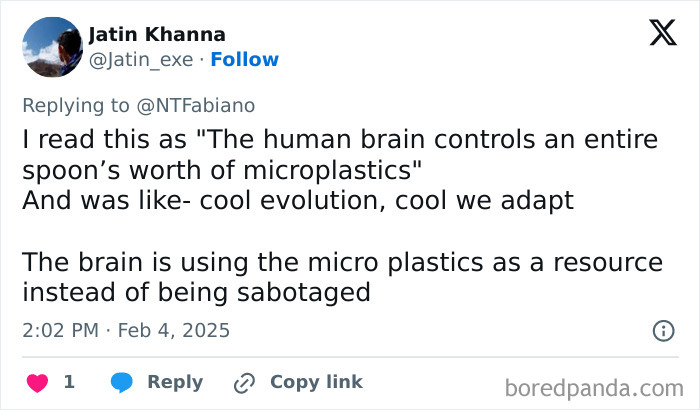
Image credits: Jatin_exe

Image credits: crazyuncletim

Image credits: Eyhabseas

Image credits: elohim9000

Image credits: BatB93354

Image credits: color_blinds

Image credits: AVP82796731

Image credits: DogeMemery
The post Since It Was Proven Our Brains Are Littered With Microplastics, Here Are Some Ways To Prevent It first appeared on Bored Panda.
from Bored Panda https://ift.tt/MinKflz
via IFTTT source site : boredpanda
