When a newborn arrives, it’s quite common to hear discussions over who the baby resembles most. Relatives often chime in, eagerly trying to point out shared features.
But one mother-in-law got the shock of her life when her son’s baby was born with a skin tone unlike either parent’s.
Throwing basic human decency and science out the window, she immediately accused the exhausted new mom of cheating. Fortunately, a supportive husband, protective hospital staff, and a glorious final reveal ultimately made this MIL realize she had put a massive foot in her mouth.
This story, shared online by the new mom, reminds us that while genetics are complex, human bias is painfully simple.
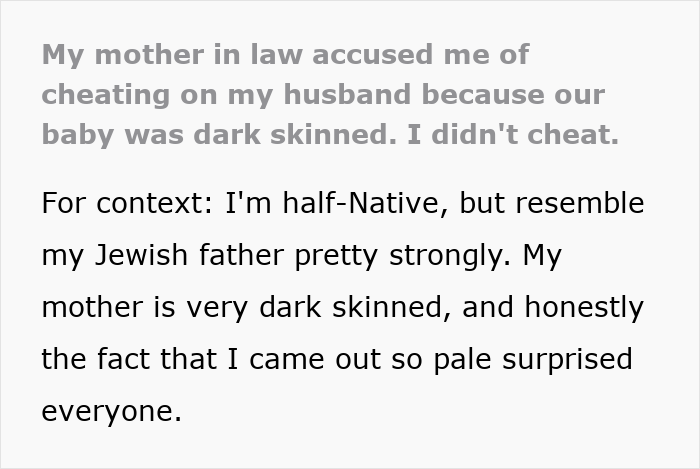
Woman gave birth to a baby girl, and suddenly the mother-in-law started acting out

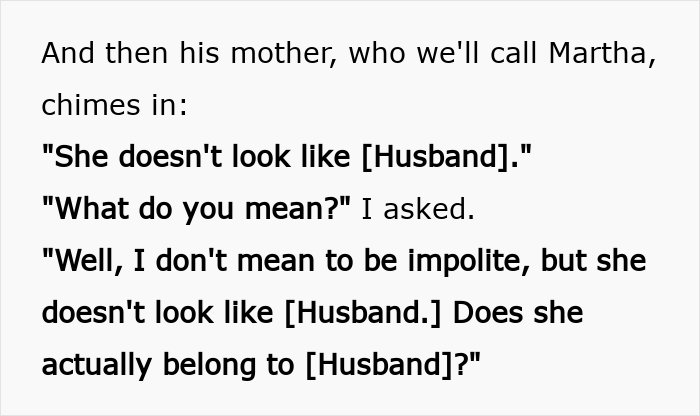
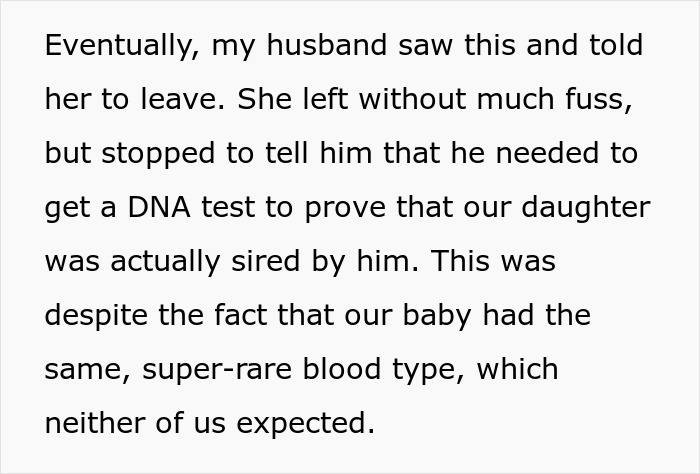
The MIL accused her of cheating because the baby had a darker skin tone







The science behind skin tone and hidden genetic traits
Dealing with a mother-in-law who makes judgment calls or wild accusations about a baby’s skin tone is a deeply hurtful and exhausting experience — whether her behavior stems from overt racism, colorism, or weaponized doubt about paternity.
But first, let’s talk science.
Human skin color is a polygenic trait, meaning it is influenced by complex interactions among dozens of genes — including major pigmentation regulators.
Because skin tone is governed by additive polygenic inheritance rather than simple “dominant vs. recessive” rules, studies show that genetic traits can remain hidden across generations.
In this story, the mother (who is half-Native) appeared pale due to polygenic variation and lack of sun exposure. However, she still carried darker pigmentation alleles from her dark-skinned Native mother.
In simple terms, skin color depends on many genes working together. And hidden traits from grandparents or other ancestors can surface suddenly.
At the same time, skin color can also change as the baby grows.
A study published in Skin Research and Technology in 2017 found that babies’ skin became lighter and less red between 2 and 20 months of age. Additionally, babies’ skin was found to increase in yellow pigment until they reached 20 months old.
However, the study noted that various ethnic skin tones may change in different ways, becoming either darker or lighter over time.
“Since a baby inherits half its genes from each biological parent, its physical appearance will be a mix of both. A baby may look more like one parent than the other, or it may look like neither,” according to an article published in Medical News Today.
Why do people get so obsessed with a newborn’s appearance in the first place?
It turns out that the mother-in-law’s instant inspection taps into a deep-seated human obsession.
Unlike mothers, fathers can never be 100% sure a child is biologically theirs without testing. Studies show that roughly 1% to 3% of children are raised by men who aren’t actually their genetic fathers. Because of this uncertainty, men naturally look for clues — and one of the main signals they rely on is how much the baby looks like them.
This is exactly why people are so deeply invested in physical resemblance. It serves as evolutionary confirmation of genetic legacy and offers psychological validation of identity.
A study published in Animal Behavior found that when fathers see their own features in their kids, they tend to spend more time with them and offer better support as parents.
Another study published in Evolution and Human Behavior shows just how deep this bias goes.
Researchers asked expectant parents who their baby resembled during a routine 20-week ultrasound. Even with blurry, 2D ultrasound images, 74% of mothers claimed the fetus looked like the father, compared to only 26% who said the baby looked like themselves. Fathers, on the other hand, split their answers roughly 50/50.
The effect was even stronger among unmarried couples, where 93% of mothers insisted the fetus looked like the dad.
Experts call this an evolutionary adaptation. Because mothers subconsciously know that fathers invest more when they feel confident in their paternity, they naturally emphasize resemblance to the father as early as possible — even before birth.
“We aimed to examine whether mothers having an ultrasound would claim that the fetus looks more like the father. Even with such limited visual information, we predicted that mothers would be more likely to say that the fetus resembled the father in an effort to assure paternity,” says Carlota Batres, one of the researchers.
The reality of dealing with toxic in-laws
A toxic person is usually described as someone whose behavior constantly drags you down. This often manifests as control, manipulation, and disrespect.
With in-laws, it can turn into a tool to overstep your personal boundaries or stir up drama in your relationship.
“Toxicity can also show up in more subtle ways like passive-aggressive comments, backhanded compliments, or an ongoing pattern of making you feel unwelcome or unworthy,” says Dr. Chris Mosunic, a licensed clinical psychologist.
He notes that some in-laws might thrive on drama and constantly try to stir up trouble between partners or other family members.
When this happens, Dr. Mosunic has one warning — don’t take the bait.
“When your in-laws behavior frustrates you it can be tempting to respond in kind. However, meeting toxic behavior with more toxic behavior only escalates the conflict.”
Instead, setting firm boundaries is the most effective way to deal with problematic in-laws. But boundary setting only works if you and your partner stand completely united, adds Dr. Mosunic.
This viral story is a reminder of how easily human evolutionary biology, unhealed prejudices, and toxic family dynamics can collide in a single room.
And while understanding basic science might be a stretch for some, showing basic human decency in a delivery room requires zero effort.
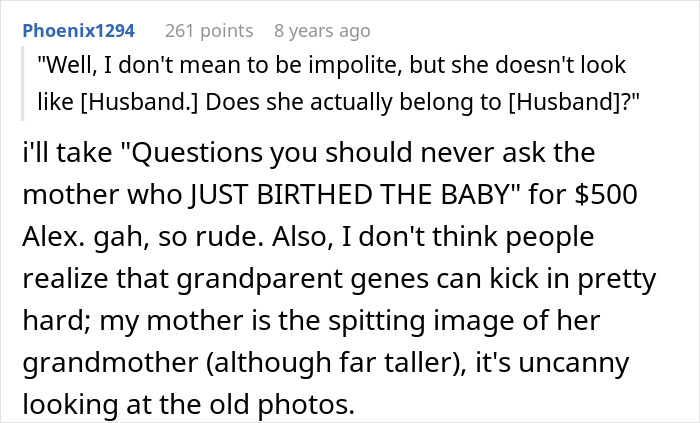
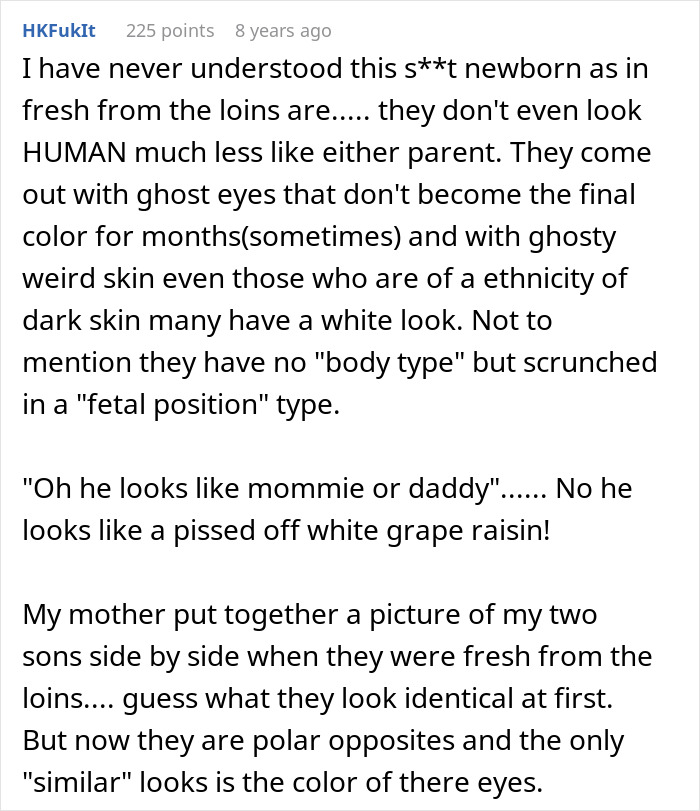
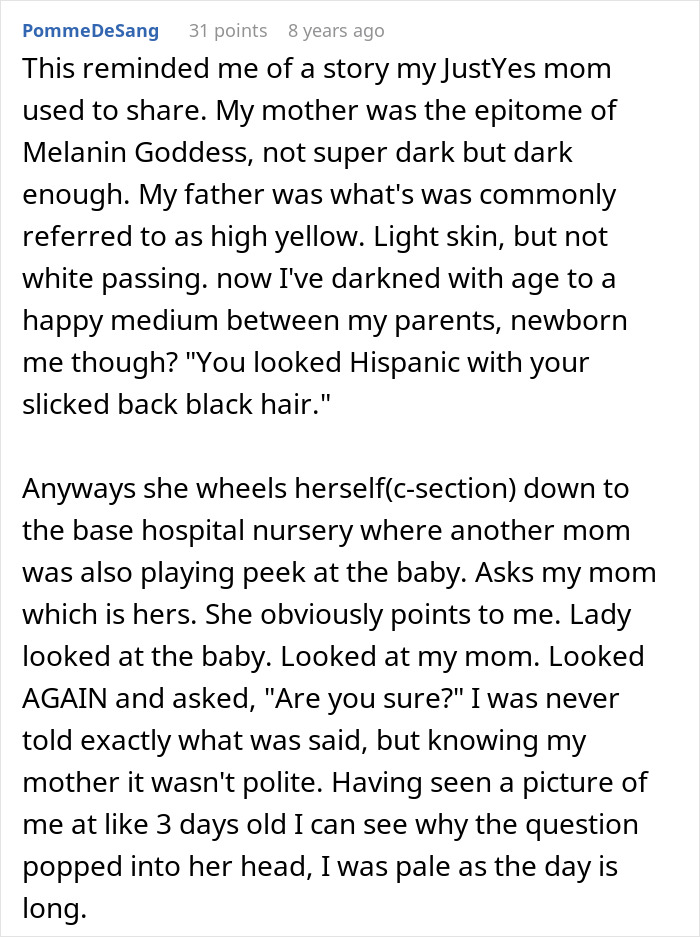
People were shocked at the audacity of the mother-in-law












from Bored Panda https://ift.tt/w6E1iHy
via IFTTT source site : boredpanda
